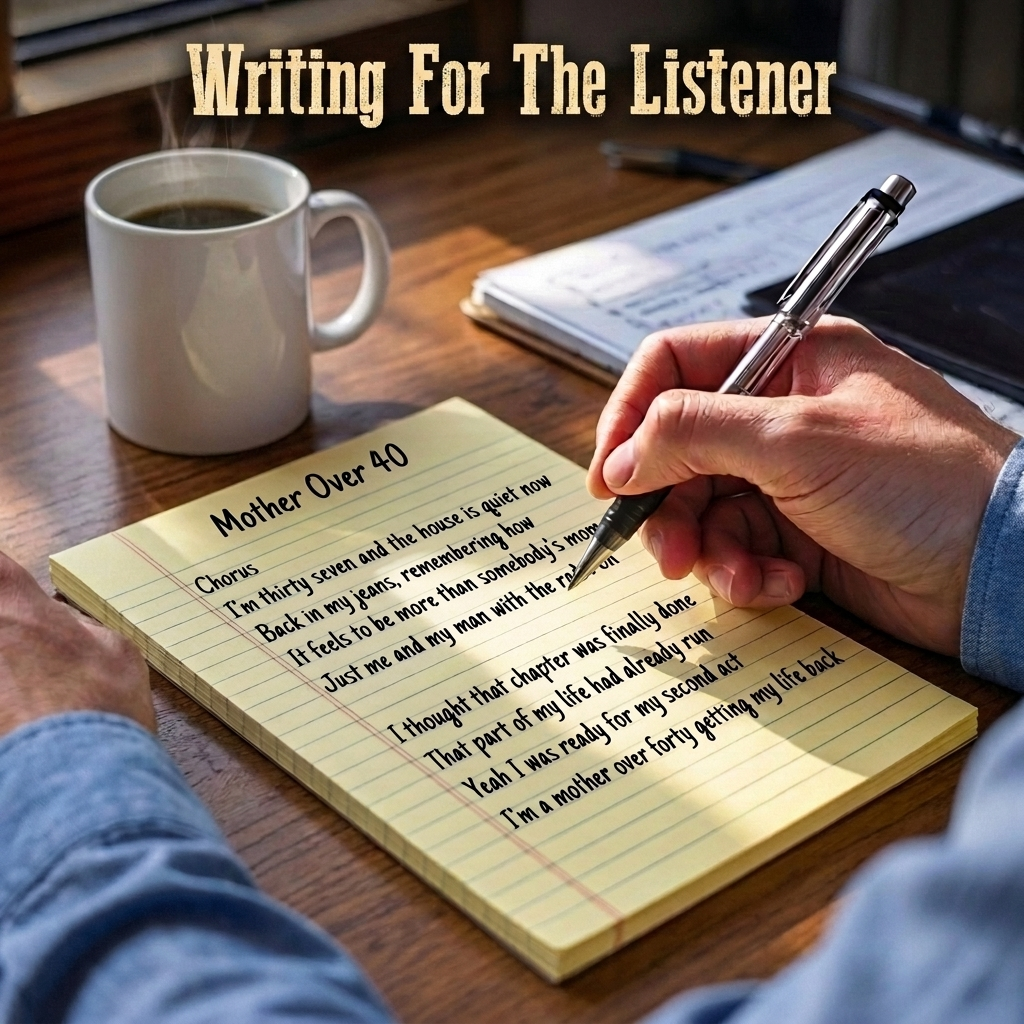
Why the best songs aren’t about what you want to say, they’re about what they need to feel
There’s a quiet trap a lot of songwriters fall into, especially the good ones.
You write something clever.
Something deep.
Something that makes you stop and go, “Man… that’s good.”
And it is good.
But it’s not landing.
Not because it’s wrong.
Not because it’s weak.
But because it’s written for the writer… not the listener.
The Hard Truth
The listener doesn’t care how smart the line is.
They care how fast they feel it.
That’s the difference between:
- A song that gets respected
- And a song that gets replayed
In Nashville terms:
- “That’s well written” = album cut at best
- “I felt that immediately” = commercial opportunity
The Listener Isn’t Studying You
They’re:
- Driving
- Sitting in traffic
- Half-listening the first time
- Deciding in 15 seconds if they’re staying or skipping
They don’t have time to figure out what you meant.
If your song requires interpretation before emotion…
you’ve already lost them.
Clarity Beats Cleverness
There’s a difference between:
Writer line:
“I exist in the absence of your presence”
Listener line:
“Ever since you left, this house don’t feel like home”
Same idea.
Only one connects instantly.
The goal isn’t to dumb it down,
it’s to speed it up emotionally.
Write So They See It
Listeners don’t connect to concepts.
They connect to moments.
Not:
- “We grew apart”
But:
- “You stopped reaching for my hand at red lights”
Not:
- “I miss you”
But:
- “I still set two cups out every morning”
If they can see it, they can feel it.
If they have to think about it, they’re gone.
The First Line Test
Your opening line has one job:
Make them lean in, immediately.
Not in 20 seconds.
Not after the pre-chorus.
Not once the melody builds.
Immediately.
Because today’s listener decides fast:
- Stay
- Skip
A strong opening doesn’t explain the song,
it drops you inside it.
The Chorus Isn’t for You
The chorus is not where you show off your writing.
It’s where you pay off the listener.
A great chorus:
- Is clear on first listen
- Can be remembered on second
- Can be sung on third
If someone has to decode your chorus, it won’t travel.
This is where a lot of strong writers miss:
They protect the clever version…
instead of choosing the singable one.
Familiar Isn’t the Enemy
Songwriters often try to avoid anything that feels “too simple” or “already done.”
But listeners don’t want new language.
They want new emotion inside familiar language.
That’s why lines like:
- “It ain’t goodbye, it’s see you later”
- “I didn’t know what I had ‘til it was gone”
Still work, when they’re anchored in a real, specific moment.
The Real Goal
You’re not trying to impress another songwriter.
You’re trying to:
- Stop someone mid-scroll
- Make them feel seen
- Give them something they didn’t know how to say
The best songs don’t sound written.
They sound recognized.
A Simple Check Before You Call It Done
Run your song through this filter:
- Would a first-time listener understand this on one pass?
- Is the emotion clear without explanation?
- Are the images concrete enough to see?
- Does the chorus land without thinking?
- Would someone want to sing this… not just admire it?
If the answer isn’t yes across the board…
You’re still writing for you.
Final Thought
Great writing gets noticed.
But great connection gets played.
And in today’s world,
the listener decides everything.
So the next time you write something clever…
ask yourself:
Does this impress me… or does it reach them?
Because the songs that build careers…
Always choose them.
Explore more songs and stories at NashvilleLyrics.com
Where real stories turn into country songs.