How many songs would you confidently play for a publisher today?
Not your favorites.
Not the ones your family likes.
Not the ones that took the longest to write.
Not the songs you feel guilty leaving behind because you remember how much work went into them.
I mean the songs you would confidently put on the table if someone in the industry looked across the room and said,
“Play me your best.”
For most songwriters, that question is surprisingly uncomfortable.
Some writers immediately answer, “Fifty.”
Others say, “I’ve got over a hundred.”
Some simply point to their catalog.
But when the question becomes more specific—which songs would you actually play first?—the number usually gets much smaller.
That realization changed the way I think about songwriting.
It changed the way I listen to my own catalog.
It changed how I prioritize rewrites, demos, pitching opportunities, and even new ideas.
Instead of asking,
“How many songs have I written?”
I started asking a much better question.
How many songs are truly ready to represent me?
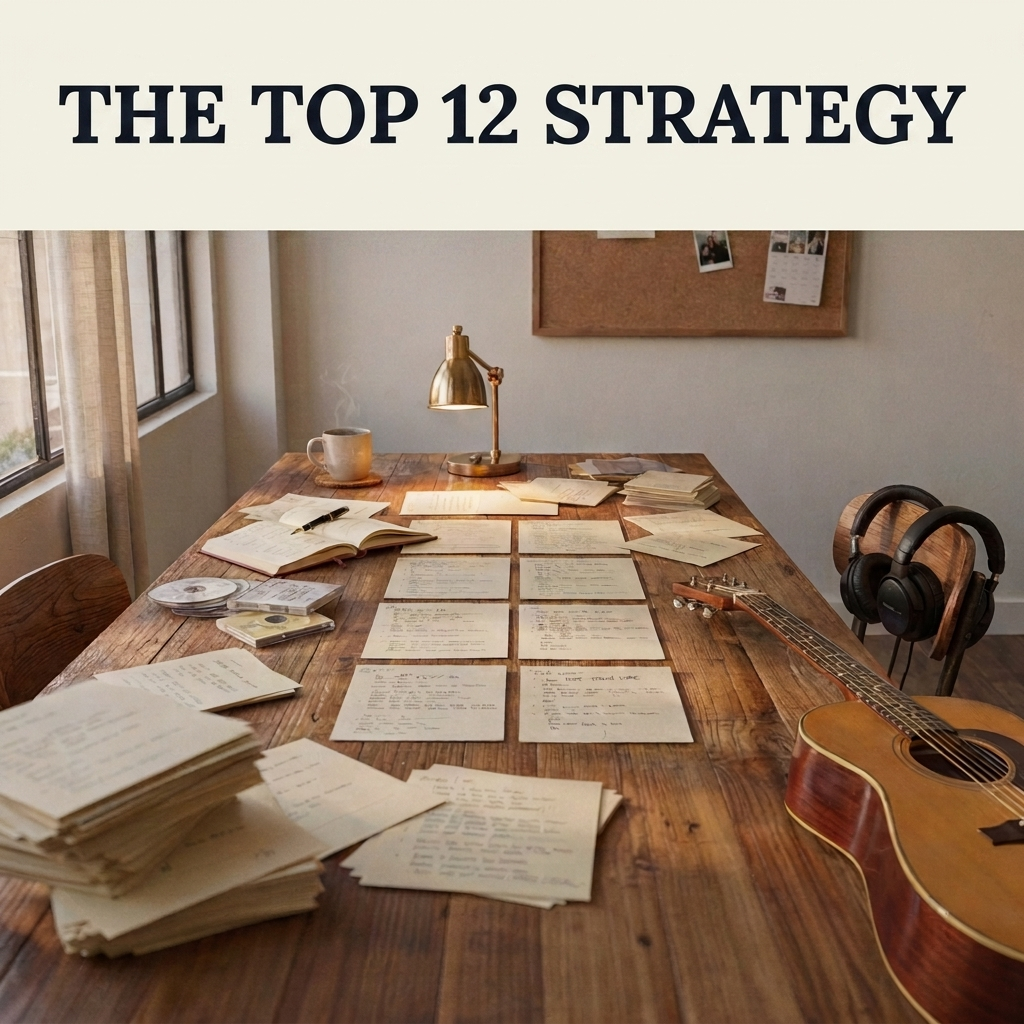
That question became the foundation of what I now call The Top 12 Strategy.
The Problem: Most Songwriters Measure the Wrong Thing
Most songwriters measure progress through accumulation.
Songs written.
Demos finished.
Copyrights filed.
Pitches sent.
Folders filled.
New ideas started.
Those things matter.
A songwriter who isn’t writing, finishing, and improving isn’t moving forward.
But accumulation can quietly become a trap.
A growing catalog creates the feeling of progress while hiding a much harder question.
How many of those songs are actually competitive?
How many would make a publisher lean forward?
How many would survive comparison with the songs professional writers are already bringing into the room?
Commercial songwriting isn’t simply about having material.
It’s about having the right material…
ready at the right time…
aimed at the right opportunity.
Every publisher, producer, artist, manager, and song plugger protects one thing above all else:
Their reputation.
Every time they recommend a song, they’re putting that reputation on the line.
That’s why professional pitches are never based on effort alone.
They’re based on confidence.
That is where many songwriters stay stuck.
They keep adding songs to the pile without ever deciding which songs have truly earned the right to lead.
The Turning Point: When More Songs Stopped Helping
At one point, I realized something uncomfortable.
Having more songs wasn’t making my catalog stronger.
It was making decisions harder.
I could scroll through titles.
Remember why I liked each one.
Explain why every chorus mattered.
Defend almost every song.
And that became the problem.
If every song required an explanation…
then the catalog was asking the listener to do too much work.
A publisher doesn’t need my explanation first.
A publisher needs the song to make the case.
If someone asks to hear my best work, I shouldn’t need twenty minutes of searching, defending, ranking, and apologizing before I press play.
So I stopped asking,
“Which songs do I still believe in?”
Instead I asked,
Which songs would I confidently play first?
Not which songs had sentimental value.
Not which songs could become better someday.
Not which songs represented how much work I invested.
Which songs would I trust…
today…
without hesitation?
That simple question became the beginning of the Top 12.
Why Twelve?
Twelve isn’t a magic number.
It’s a manageable one.
A Top 12 is large enough to show range…
different tempos…
different emotional lanes…
different artist opportunities…
…but small enough to force honesty.
If a song reaches the Top 12, it has earned a specific responsibility.
It isn’t simply part of the collection.
It’s part of the front line.
Imagine sitting across from a publisher.
They look up and say,
“Play me your three best songs.”
Could you press play within thirty seconds?
Or would you begin explaining…
searching…
re-ranking…
second-guessing…
…and apologizing?
I call this The Play Button Test.
The longer it takes to decide what to play…
the less likely you’ve actually identified your best work.
Professional catalogs are curated.
Not accumulated.
That doesn’t mean every song outside the Top 12 lacks value.
It simply means not every song should be leading the conversation.
The Hidden Benefit: Your Best Songs Teach You What Better Looks Like
The Top 12 doesn’t only help publishers.
It helps the songwriter.
Once you’ve identified your strongest songs, every new song has a benchmark.
You begin hearing your own catalog differently.
You know what quality feels like.
You know which hooks consistently compete.
You know which emotional lanes keep producing your strongest work.
You recognize which productions elevate the song…
and which simply decorate it.
That awareness changes the writing process.
Instead of treating every idea equally, you begin asking better questions.
Does this song challenge the Top 12?
Does it expose a weakness in the catalog?
Does it open a lane I’m missing?
Does it belong in my active pitch list…
or is it simply a promising idea that still needs development?
The Top 12 becomes a living mirror.
It shows you what you’re actually building…
not what you hope the catalog says about you.
The Categories: A Simple Way to Organize the Catalog
You don’t need a complicated system to make better decisions.
You need an honest one.
For me, every completed song eventually falls into one of four categories.
Category 1 — Ready to Lead
These are the songs I would confidently pitch today.
They represent the strongest combination of:
- Hook
- Emotional impact
- Commercial appeal
- Current market fit
- Production quality
- Artist opportunity
These songs become the foundation of the Top 12.
They’re the first songs I would play in a publisher’s office.
They’re the songs trusted to represent the catalog.
Category 2 — Strong, But Not First
These are excellent songs.
They may become outstanding album cuts.
They may fit a particular artist.
They may find the right opportunity later.
But if someone asks to hear my very best work…
these aren’t the first songs I reach for.
That doesn’t diminish their value.
It simply recognizes that every catalog needs role players as well as starters.
Category 3 — High Potential
These songs aren’t finished yet.
The title may be strong.
The concept may be compelling.
The emotional lane may be exactly right.
But something still needs to improve.
Maybe the chorus hasn’t fully landed.
Maybe the production doesn’t support the lyric.
Maybe the bridge needs another rewrite.
Maybe the song simply needs time.
These aren’t failed songs.
They’re developing songs.
Sometimes one rewrite is all that separates Category 3 from Category 1.
Category 4 — Archive, Hold, or Retire
This category is often misunderstood.
Archive doesn’t mean failure.
Hold doesn’t mean forgotten.
Retire doesn’t mean worthless.
Some songs taught me something important.
Some captured a season of life.
Some simply made way for stronger songs that came later.
Others may eventually return when I have more experience, a different perspective, or a better production approach.
Good songs deserve patience just as much as they deserve enthusiasm.
Not every song has to compete today.
Some songs simply haven’t reached the right moment yet.
This framework keeps the catalog from becoming one emotional blur.
It allows every song to have a purpose without pretending every song has the same responsibility.
And perhaps most importantly…
it gives the songwriter permission to be honest.
The Emotional Challenge: Choosing Is Harder Than Writing
The Top 12 Strategy sounds practical.
It is.
But it is also deeply emotional.
It asks you to admit that one of your favorite songs may not be one of your best songs.
It asks you to retire songs you still respect.
It asks you to rewrite songs you thought were finished.
It asks you to stop using effort as evidence.
That is difficult because songwriters remember the entire journey.
We remember the title that appeared out of nowhere.
The line that took three days to finish.
The demo session.
The money invested.
The friend who said, “This is my favorite.”
The version of ourselves that needed to write that song.
The listener doesn’t hear any of that.
The listener hears the song.
That is why choosing is one of the most professional skills a songwriter can develop.
Writing creates options.
Choosing creates direction.
Professional careers are usually built on direction, not volume.
A catalog grows because you keep writing.
A career grows because you learn what deserves to move forward.
In My Own Catalog
The Top 12 Strategy isn’t theory for me.
It came directly from building my own catalog.
Over time, I’ve watched songs move through every category.
One example began as a concept called Jealousy, evolved into The Truth Untold, and ultimately became I Held On Too Tight.
The emotional foundation never changed.
But each rewrite sharpened the story, strengthened the title, simplified the lyric, and brought the song closer to the emotional truth I was trying to capture.
The final version earned its place because the execution finally matched the idea.
More recently, Just Once taught me a different lesson.
During production, several lyrics that looked perfectly natural on paper simply didn’t sing naturally.
The melody exposed conversational phrases that felt awkward.
The pre-chorus became stronger.
The bridge was rewritten several times.
Even the ending changed.
None of those revisions altered the concept.
They simply allowed the performance to reveal what the song had been trying to become all along.
That process elevated Just Once into my Category 1 list—not because the idea changed, but because the delivery finally matched the emotion.
Other songs taught me the opposite lesson.
Concrete in the Corn is a concept I still believe in.
The foundation is there.
The story is there.
The message still resonates.
But instead of forcing it into the Top 12 before it was ready, I chose patience.
Good songs deserve time to mature just as much as they deserve enthusiasm.
That may be one of the biggest lessons this strategy has taught me.
A song’s current ranking is not a permanent judgment of its value.
It is simply an honest assessment of where that song stands today.
A Top 12 Isn’t a Trophy Case
One mistake I see songwriters make is treating their catalog like a museum.
Once a song is finished…
it stays exactly where it is forever.
Professional catalogs don’t work that way.
A Top 12 isn’t a trophy case.
It’s a depth chart.
Songs earn their way into the lineup.
Songs move up because a rewrite unlocks something new.
Songs move up because stronger production finally lets the lyric breathe.
Songs move up because the market changes or an artist suddenly creates a new opportunity.
Songs also move down.
Not because they became worse.
Because stronger songs arrived.
That’s healthy.
It means the catalog is improving.
If your Top 12 never changes, there’s a good chance your songwriting isn’t changing either.
Growth should create movement.
That’s exactly what you want.
What the Top 12 Changed
Once I began thinking this way, the catalog became remarkably clearer.
I stopped asking,
“What should I write next?”
and started asking,
“What deserves to stay in the Top 12?”
That single question changed almost every creative decision that followed.
Every new song suddenly had something to challenge.
A finished song was no longer successful simply because it existed.
It became successful if it raised the standard.
If it filled a missing lane.
If it became a stronger representative of the catalog.
Or if it taught me something that made the next song even better.
The strategy also changed how I approached rewriting.
Instead of vaguely trying to improve everything…
I knew exactly which songs deserved another round of work.
Some songs didn’t need another demo.
They needed another draft.
Some didn’t need another rewrite.
They needed to step aside so stronger songs could finally be heard.
That is the difference between maintaining a catalog…
and strategically building one.
The Top 12 Is a Living Benchmark
The Top 12 should never become permanent.
If the list never changes…
you probably aren’t growing.
Songs move up.
Songs move down.
New songs earn opportunities.
Older songs sometimes return stronger than ever.
That’s exactly how it should work.
The goal isn’t stability.
The goal is clarity.
A living benchmark constantly reminds you where your best work actually lives.
It gives every new song something meaningful to compete against.
It gives every rewrite a purpose.
It gives every pitch confidence.
Most importantly…
it removes the pressure to pretend every finished song deserves the same responsibility.
They don’t.
And they were never meant to.
Closing
The goal isn’t to build the biggest catalog.
It’s to build the strongest one.
Every songwriter can write another song.
Professional songwriters learn which songs deserve another year of their attention.
Your catalog is not a museum.
It is a team.
Every team has starters…
role players…
developing prospects…
and veterans waiting for the right opportunity.
A healthy catalog works exactly the same way.
The Top 12 Strategy helps you know the difference.
It reminds you that finished doesn’t always mean ready.
It reminds you that good doesn’t always mean best.
And it gives every new song a standard worth chasing.
Because when someone finally looks across the table and asks,
“What’s your best work?”
your answer shouldn’t begin with an explanation.
It shouldn’t begin with a folder full of demos.
It shouldn’t begin with a list of songs you’re still hoping someone else will sort through.
It should begin with the play button.