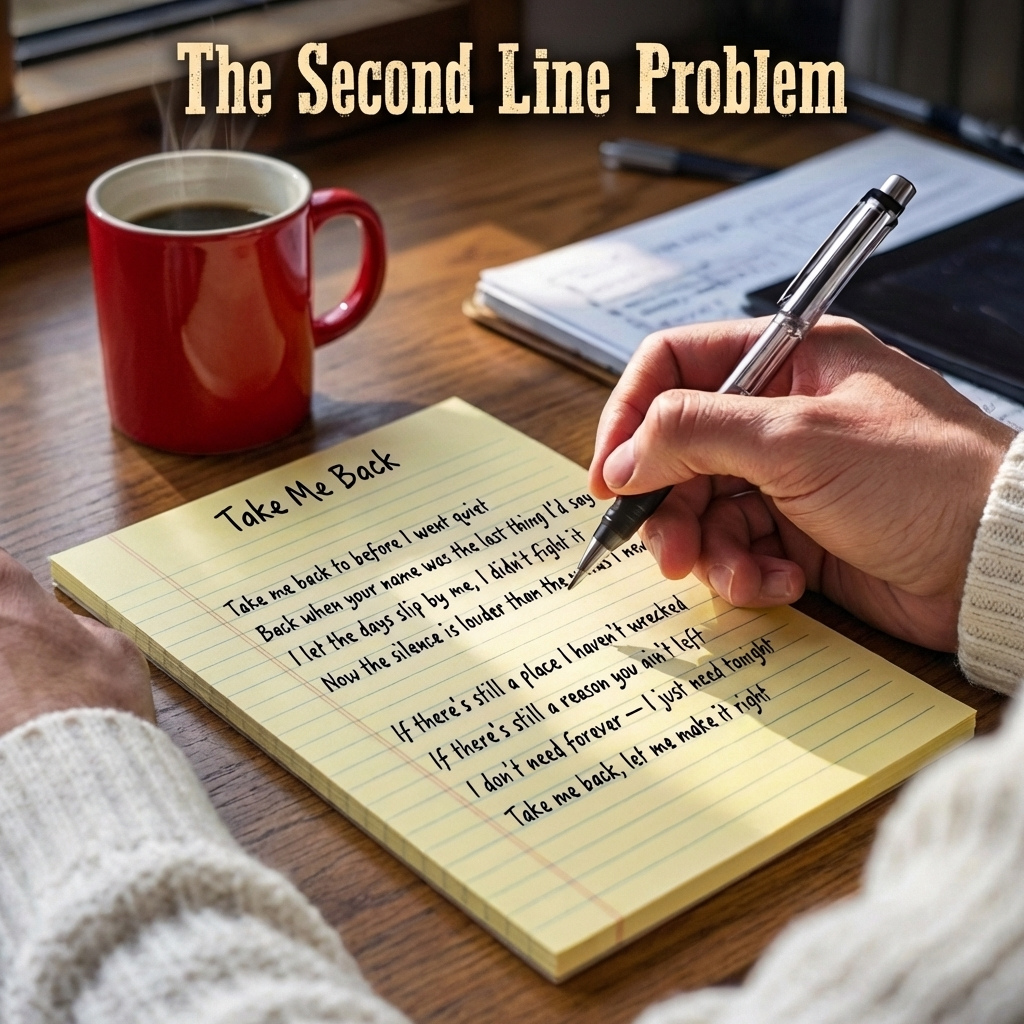
Most songwriters don’t struggle with starting a song.
They struggle with the second line.
That might sound simple, but it’s one of the most common reasons good ideas never become great songs. You come up with a strong opening—something that feels fresh, emotional, or clever—and for a moment, it feels like you’ve got something.
Then the next line shows up… and the momentum disappears.
That drop in energy is what I call The Second Line Problem.
Why the First Line Works (and the Second Often Doesn’t)
The first line usually comes from instinct.
It’s the spark—the moment of clarity, the phrase that feels like a hook, the line that made you stop and write it down in the first place. It carries energy because it hasn’t been overthought.
The second line, on the other hand, often comes from pressure.
Now the brain steps in:
- Where is this going?
- What should I say next?
- How do I make this make sense?
And that’s where things start to flatten out.
Instead of building on the emotion of the first line, the second line often explains it… or worse, weakens it.
The Real Issue: Loss of Tension
A strong first line creates tension.
It introduces something unresolved—a question, a feeling, an image that makes the listener lean in.
The second line has one job:
Keep that tension alive.
But many second lines accidentally release it too early.
Example of the Problem:
Line 1:
“I saw your truck outside his house last night”
That line creates immediate tension. There’s a story here.
Weak Line 2:
“And I couldn’t believe what I was seeing”
Now the tension drops. Instead of advancing the story, the line explains the emotion the listener already understands.
Stronger Line 2:
“Parked where mine used to be”
Now the tension builds. The story moves forward. The emotional weight increases without explanation.
What Strong Second Lines Actually Do
A great second line doesn’t repeat the first—it deepens it.
There are three ways it typically does this:
1. It Adds Specificity
Instead of staying broad, it sharpens the image.
Line 1:
“There’s a picture on the dashboard I still keep”
Line 2 (strong):
“Faded from the Georgia heat”
Now the listener sees it.
2. It Introduces Contrast
A strong second line can shift perspective slightly—adding complexity without losing direction.
Line 1:
“You said forever like it meant something”
Line 2 (strong):
“I heard it like it did”
Now we have two perspectives in tension.
3. It Moves the Story Forward
The best second lines don’t pause—they progress.
Line 1:
“We were talking ‘bout leaving this town”
Line 2 (strong):
“You already had one foot out”
Now the story is moving, not stalling.
Why This Matters More Than You Think
Listeners don’t consciously analyze second lines—but they feel them.
If the second line loses energy:
- The verse feels flat
- The listener disengages early
- The chorus has to work harder to recover
In many cases, the song never fully regains that initial momentum.
That’s why the first two lines of a song are often the most important eight seconds you’ll write.
The Fix: Write Forward, Not Down
Most weak second lines come from writing “downward”—explaining or softening what was just said.
Strong second lines write forward.
They:
- Add information
- Increase tension
- Keep the listener leaning in
A simple check:
If your second line explains the first line, it’s probably wrong.
If it makes the listener more curious, you’re on the right track.
A Simple Rewrite Technique
When you hit a second line that feels flat, don’t force it—shift your approach.
Try this:
- Write your first line
- Pause
- Ask: “What’s the next visual or action—not the explanation?”
This keeps you in story mode instead of analysis mode.
Final Thoughts
The difference between a good song and a great one often isn’t the idea.
It’s the execution—line by line, moment by moment.
The first line gets your attention.
The second line decides whether you stay.
Because once the momentum is gone, it’s hard to get it back.
So the next time you write something that feels strong, don’t rush past the moment.
Protect it.
Build on it.
And make sure your second line earns its place.