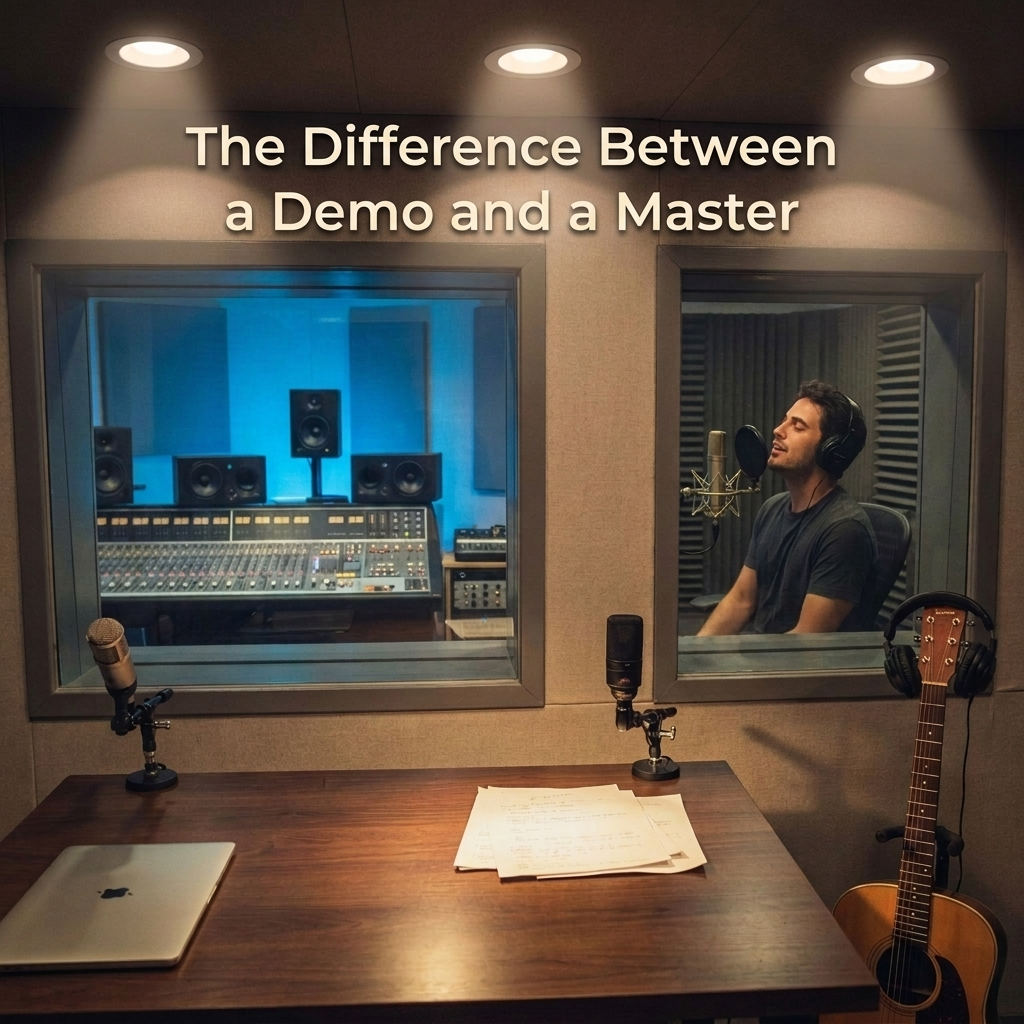
When Does a Song Stop Being a Demonstration and Become the Finished Recording?
Songwriters use the word demo constantly.
Then there is another word that sounds like the next level:
master.
It’s tempting to think the difference is simple.
A demo is rough.
A master sounds professional.
But that’s not always true.
Modern demos can sound remarkably polished. Home studios, digital production and newer creative tools have dramatically narrowed the gap between what an independent songwriter can produce and what once required a major recording studio.
So what actually separates a demo from a master?
The answer starts with purpose.
What Is a Demo?
A demo exists primarily to demonstrate the song.
Its job is to communicate:
- the lyric,
- the melody,
- the structure,
- the emotional direction,
- and enough production context for someone to understand what the song could become.
For a songwriter pitching a composition, that’s often exactly what is needed.
The artist, publisher or producer isn’t necessarily evaluating whether that exact recording belongs on an album.
They’re evaluating the song underneath it.
Can they hear themselves—or their artist—singing it?
That’s the job of the demo.
A Demo Doesn’t Have to Sound Cheap
This is where the old definition starts breaking down.
A demo doesn’t have to be one singer and an acoustic guitar recorded into a microphone.
It can have:
- full instrumentation,
- strong vocals,
- polished production,
- professional mixing,
- and excellent audio quality.
It can sound surprisingly close to something you’d hear commercially.
And it can still be a demo.
Why?
Because the recording’s primary purpose is still to represent the composition, not necessarily to become the commercially released recording itself.
So What Is a Master?
A master is the finished recording intended for commercial use.
Instead of asking:
“Does this recording demonstrate the song?”
the question becomes:
“Is this the recording we want the public to hear?”
That changes the standard.
Now every detail matters:
the vocal performance,
the arrangement,
the mix,
the edit points,
the beginning,
the ending,
the noise floor,
the dynamics,
and the final delivery format.
There is no future artist expected to reinterpret it.
This recording is the product.
The Same Song Can Need Both
Imagine I’ve written a country song intended for another artist.
I may create a highly polished demo so the artist can hear exactly how the song works.
If the artist decides to record it, they’ll probably create an entirely new master.
Same composition.
Different recording.
Different purpose.
But if I’m releasing my own recording directly to listeners, the situation changes.
Now the recording itself has to survive commercial scrutiny.
That’s when I’m no longer asking whether the song is represented well enough.
I’m asking whether the recording itself is finished.
Don’t Confuse File Quality With Recording Quality
This is another important distinction.
Exporting a recording as a high-quality WAV file doesn’t magically turn it into a master.
Likewise, an MP3 isn’t automatically a demo.
File format and recording status aren’t the same thing.
A technically excellent file can contain a weak recording.
A compressed listening copy can represent an excellent master.
Audio specifications matter for delivery.
But the designation begins with the purpose and quality of the actual recording.
Pitch-Ready Can Live Between the Two
For songwriters, there’s also a useful middle ground:
pitch-ready.
A pitch-ready demo doesn’t necessarily need to compete sonically with a major-label release.
But it shouldn’t force the listener to imagine past obvious problems either.
The vocal should communicate the song.
The arrangement should make sense.
The lyrics should be understandable.
The production should support the intended lane.
And nothing about the recording should distract from the composition.
That’s the standard I care about most when evaluating material intended for pitching.
Don’t Overproduce the Wrong Song
There’s another lesson buried in this distinction.
Production can’t rescue writing that isn’t ready.
It’s easy to keep improving:
the guitars,
the drums,
the vocals,
the mix,
the effects.
But if the second verse isn’t working, none of those things solve the actual problem.
Before investing more effort into the recording, make sure the composition deserves it.
Sometimes the most professional decision is another rewrite.
Know What You’re Building
Before producing a song, ask:
What is this recording supposed to do?
If it’s intended to communicate a composition to an artist, build an excellent demo.
If it’s intended for commercial release, build toward a master.
If it’s an early writing reference, don’t spend three days polishing something that may be rewritten tomorrow.
Matching the production investment to the purpose saves time, money and frustration.
Final Thought
The difference between a demo and a master isn’t simply how expensive the recording sounds.
It’s what you’re asking the recording to accomplish.
A demo says:
“Here’s the song.”
A master says:
“Here’s the record.”
Know which one you’re making before you press Record.