
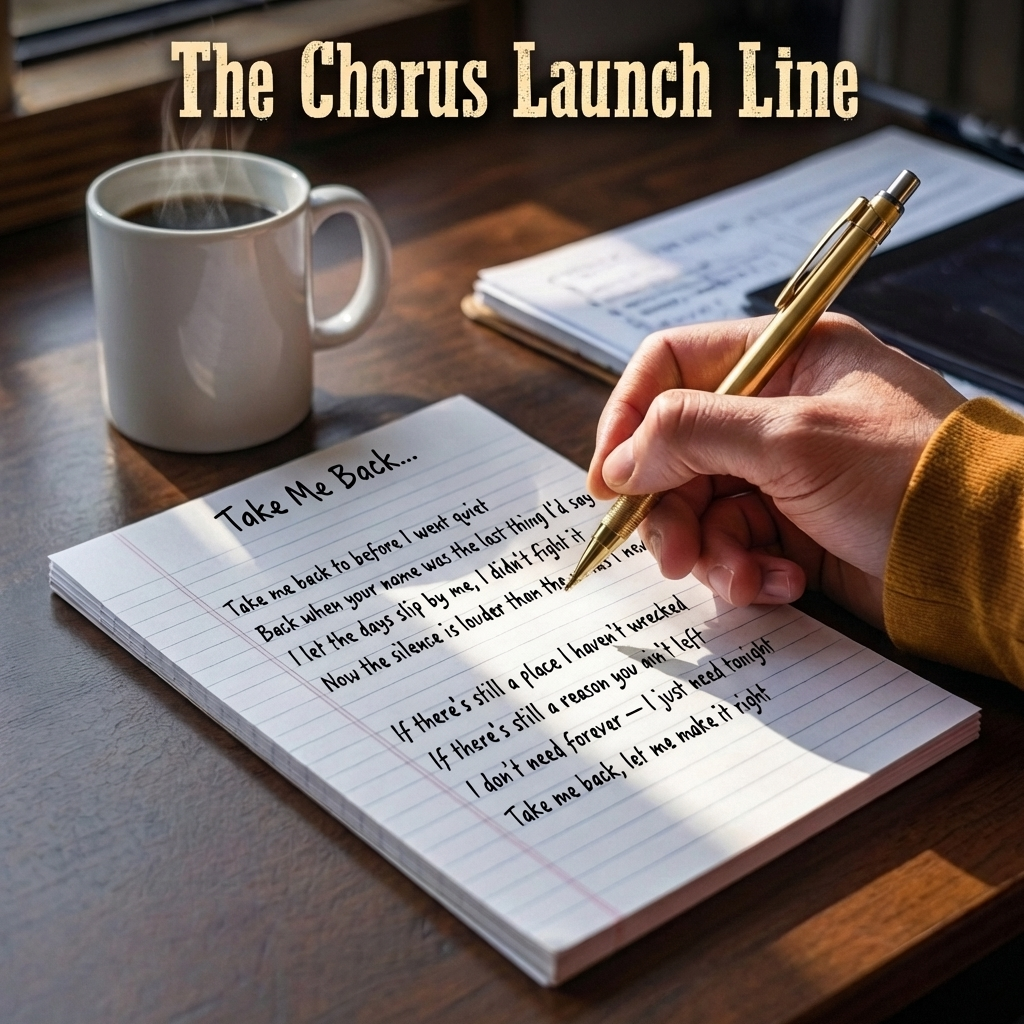
Most songwriters have experienced this frustration:
You write a chorus with a solid hook, a strong title, and lyrics that should work, yet the song still doesn’t hit the way you expected.
Often, the problem isn’t the chorus itself.
It’s how the chorus arrives.
Some choruses feel inevitable, like the song suddenly opens up. Others feel rushed, even when the writing is strong. That difference usually comes down to one overlooked moment: the first two seconds of the chorus.
That moment is what I call the Chorus Launch Line, and it’s one of the quiet separators between a good song and a great one.
What Is a Chorus Launch Line?
The Chorus Launch Line is not just the first line of the chorus.
It’s the emotional and melodic moment that signals payoff, the instant the listener realizes, “This is the point of the song.”
In practice, it usually lives in:
- A brief pause or beat drop
- A stretched or spaced vocal phrase
- A repeated or emotionally charged fragment of the hook
Think about choruses you recognize instantly. You often don’t need the full line—you recognize the arrival. The song doesn’t simply continue; it announces itself.
That announcement typically happens in the first 2–3 seconds, and when it’s missing, even a great hook can feel forgettable.
Why Nashville Writers Obsess Over Chorus Entry
In modern country writing rooms, especially in Nashville, three values dominate chorus construction:
- Immediacy
- Clarity
- Sing‑back moments
A chorus has to feel bigger than the verse and arrive with confidence. Listeners decide quickly whether a song is worth leaning into, and the chorus is where that decision is confirmed.
This is why so many professional writers pay close attention to how the chorus enters, not just what it says.
A weak chorus entry can make a strong hook feel uncertain. A strong entry gives the hook authority.
You can hear this in countless modern country records where the first chorus feels like a release, whether it’s a moment of silence before the downbeat, a held note that creates space, or a repeated title that locks into memory immediately.
The Three Elements of an Effective Chorus Launch Line
1. The Micro‑Pause
A brief pause, sometimes just a half beat, creates anticipation. It’s especially powerful after a lyric‑heavy pre‑chorus.
That moment of space tells the listener: something bigger is coming.
Many choruses fail not because they arrive too late, but because they arrive too fast. Silence, used intentionally, creates emotional lift.
2. Melody Spacing
Great chorus entries often use:
- Longer vowels
- Fewer syllables
- Clear phrasing breaks
This allows the vocal to breathe and gives the chorus a distinct identity from the verse. Instead of rushing the first line, the melody stretches just enough to let the emotion land.
You hear this technique constantly in choruses that feel instantly singable, even before you know all the words.
3. Early Hook Repetition
One of the most effective launch techniques is repeating the title or hook immediately, before the chorus expands into story or detail.
Repetition builds:
- Memory
- Confidence
- Authority
Rather than saving the hook for later in the chorus, the song plants its flag right away.
Putting It Into Practice: “That Girl Ain’t Me”
In my own song That Girl Ain’t Me, the original chorus entry worked, but it didn’t fully announce itself.
The fix didn’t require rewriting the chorus. It required rethinking the entrance.
The changes were subtle but important:
- The first line was broken into two phrases
- The hook was repeated immediately
- The melody was given space before the narrative continued
Instead of feeling like a continuation of the verse, the chorus became a statement. The listener knows, within seconds, what the song is about and why it matters.
That’s the power of a launch line: emotional authority without lyrical overload.
Common Chorus Entry Mistakes
Many writers unintentionally weaken their choruses by:
- Rushing the first line
- Treating the chorus like “Verse 3”
- Saving the hook for later
- Overloading syllables right at entry
None of these are fatal, but together they can make a chorus feel smaller than it should.
A Small Change That Changes Everything
Here’s the encouraging part:
You don’t need to rewrite your chorus.
You need to rethink how it arrives.
The Chorus Launch Line is about:
- Timing
- Space
- Conviction
When those elements are in place, the chorus doesn’t ask for attention, it takes it.
A chorus doesn’t just need to be good.
It needs to arrive like it knows it’s the point of the song.