How a Curiosity About Making Songs Turned Into Building a Music Catalog
Nashville Lyrics didn’t begin with a business plan.
It didn’t begin with a publishing company, a website, copyright registrations or a catalog prepared for industry professionals.
It started with curiosity.
I heard a podcast where someone talked about listening to music he’d created from his own lyrics. He was writing the words and using AI music technology to turn them into complete songs.
So I listened to a few.
My first reaction was pretty simple:
Wait a minute. This is actually pretty good.
Then came another thought:
Could I do that?
That question eventually became Nashville Lyrics.
But it didn’t happen all at once.
Looking back, the journey really happened in three phases.
Phase One: Wait… I Can Make a Song?
The first phase was pure experimentation.
I discovered that I could write lyrics, put them into a music generator and suddenly hear something resembling an actual song come back.
At the time, I had very little idea what I was doing.
Some of those early efforts were pretty rough.
Structure wasn’t always right.
Lyrics needed work.
Production choices were inconsistent.
But that almost didn’t matter.
The important thing was that the process sparked something.
For the first time, words I had written weren’t simply sitting on a page.
I could hear them.
And once I heard that possibility, I wanted to get better at it.
Phase Two: Maybe I Can Actually Learn This
The second phase was learning.
I began studying lyric structure, song structure and what makes commercial country songs work.
I wrote more.
I listened differently.
I began paying much closer attention to verses, pre-choruses, choruses, hooks, titles and emotional progression.
Some of those early songs sounded good to me.
A few even made me think:
I could hear something like this on the radio.
Whether anybody else would have agreed at the time is another question.
I was still undisciplined.
I was still learning.
And much of it was still entertainment.
But the standard was beginning to change.
Then I wrote a particular country song that felt different.
For the first time, I thought there might be genuine commercial potential in what I was doing.
That’s when the third phase began.
Phase Three: Treat It Like It Matters
Once I believed the songs could become commercially competitive, I had to look differently at everything I’d already done.
The earlier work needed polishing.
Some songs needed rewriting.
Others needed better production.
And the growing list of ideas in my head needed somewhere to go.
Fortunately, I had been keeping a running log of song concepts.
That list kept growing.
And growing.
Eventually there were well over 100 ideas waiting to be explored.
Meanwhile, I was reading books, studying other writers and putting considerably more effort into understanding commercial songwriting.
Around the time I’d written roughly my tenth serious country song, something clicked.
I wasn’t running out of ideas.
Quite the opposite.
There were story songs.
Radio-oriented songs.
Heartland songs.
Relationship songs.
Family songs.
Funny songs.
And concepts I hadn’t even begun to develop.
The possibilities seemed endless.
More importantly, I was having fun doing it.
That’s when the question changed from:
Can I write songs?
to:
What would it take to build something around them?
That question became Nashville Lyrics.
Why Build a Business?
I could simply write songs under my own name and attempt to pitch them.
But the music business has changed considerably.
Someone I know once told me about attending songwriting camps decades ago when writers could sometimes pitch lyrics without melody.
For somebody entering the industry from the outside today, I think that’s a much harder proposition.
We’re living in an instant-access world.
People are accustomed to hearing an idea immediately.
They don’t necessarily want to imagine:
the melody,
the singer,
the tempo,
the arrangement,
or what the chorus might sound like.
If I can present lyrics and music together, the listener can evaluate the complete concept immediately.
That’s a significant advantage.
The goal with Nashville Lyrics became bigger than accumulating written lyrics.
I wanted to build a catalog where someone could hear the song, understand its direction and quickly decide whether it might fit an opportunity.
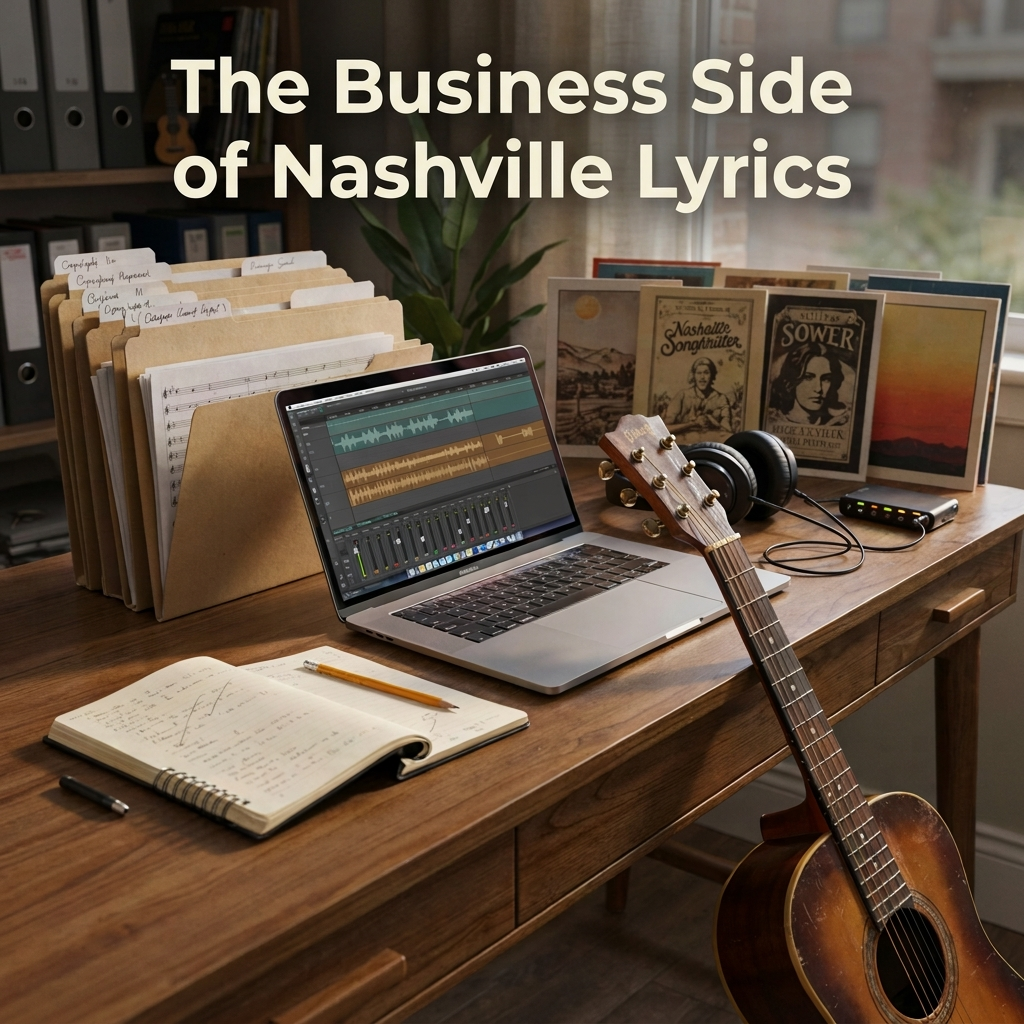
A Song Catalog Needs Infrastructure
That’s where songwriting starts turning into business.
Songs need to be organized.
Lyrics need to be finalized.
Recordings need to be identified correctly.
Writer and publisher information needs to be accurate.
Copyrights need to be registered.
Performance-rights information needs to be maintained.
Metadata needs to be consistent.
The website needs to work.
Industry-facing materials need to be professional.
And the catalog has to remain usable as it grows.
None of that writes a better chorus.
But without it, even a good song can become difficult to manage professionally.
The Paperwork Was a Surprise
One of the biggest surprises has been how much work happens after the creative work.
Song revisions.
Production revisions.
Copyright registrations.
ASCAP registrations.
Catalog updates.
Metadata.
Website maintenance.
Social media.
Blog articles.
Artwork.
Pitch preparation.
Industry platforms.
File management.
There is always another piece.
A year earlier, if someone had told me I’d eventually have dozens of copyrighted songs, writer and publisher registrations with ASCAP, a functioning music website, social media channels and an industry catalog represented on DISCO, I’m not sure I would have believed them.
Getting there required much more than writing songs.
It required building the machinery around them.
The Industry Is Moving Quickly
The other major surprise is how rapidly the music business itself is changing.
AI is clearly part of that disruption.
Distribution platforms, rights organizations, streaming services and other parts of the industry are still determining how new production technology fits into existing systems.
That creates opportunities.
It also creates hurdles.
My conclusion hasn’t been that technology allows someone to generate 1,000 songs and suddenly create a successful music business.
Quite the opposite.
Producing more material makes judgment more important.
Which ideas deserve development?
Which lyrics need another rewrite?
Which recordings are strong enough?
Which songs belong at the front of the catalog?
Which ones aren’t ready?
Technology can accelerate creation.
It doesn’t eliminate standards.
Make Mistakes Early
I’ve made mistakes building Nashville Lyrics.
Some songs weren’t good enough.
Some production choices needed to be revisited.
Some organizational systems had to change after the catalog became larger.
That’s part of building something.
The lesson has been simple:
Make the mistake. Learn from it. Correct it. Move forward.
Waiting until everything is perfect would probably mean never starting.
The goal isn’t to avoid every wrong turn.
It’s to recognize one before traveling too far down the road.
The Business Exists to Support the Songs
With all the discussion about publishing, copyright, metadata, websites and technology, it’s easy to lose sight of something important.
Nashville Lyrics exists because I enjoy writing songs.
The business structure isn’t the creative purpose.
It’s there to support it.
It gives the songs somewhere to live.
It provides a way to organize them.
It protects the work.
It makes the catalog easier to present.
And hopefully, it creates more opportunities for the right song to eventually reach the right person.
Final Thought
Nashville Lyrics started because I heard somebody turn his own words into music and wondered whether I could do the same thing.
That curiosity became experimentation.
Experimentation became education.
Education became discipline.
And eventually, discipline became a business.
There’s still plenty to learn.
The industry will continue changing.
The catalog will continue changing with it.
But the basic goal has become pretty clear:
Write better songs. Build a better catalog. And create a professional home for both.