
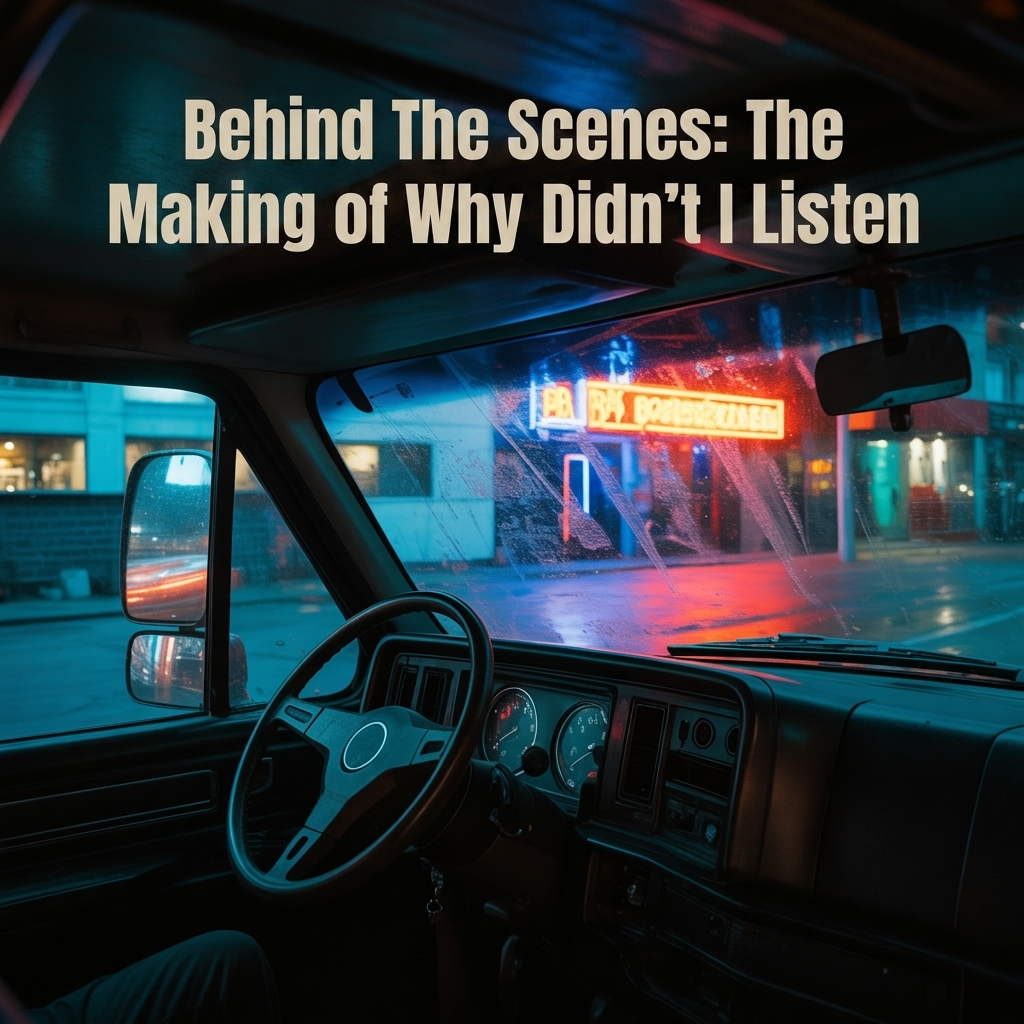
A Modern Country Story About Speed, Pride, and the Moment Everything Changes
Some songs start with a melody.
This one started with a scene that stuck in my thoughts for a few days.
While traveling through Atlanta on I-75, I came up on the aftermath of a three-car accident. From the way traffic had been moving, and the way the vehicles sat, it looked like a young driver in a new sports car had been weaving and pushing it… until the road pushed back.
Standing there in that sudden stillness, one thought kept coming back:
I bet somebody told him to slow down a thousand times.
That question became the title, the hook, and the heart of the song:
“Why Didn’t I Listen.”
🎧 Listen to a 32 second sample of the song
🔊 Tip: Check your volume before playing the preview.
The Big Idea: Speed as a Scene, and a Metaphor
On the surface, this is a high-octane story, neon, loud speakers, tires screaming, a fast lane that feels like freedom… right up until it doesn’t.
But the song was written to live on two levels.
“Fast” isn’t just the driving.
It’s the personality.
It’s the kind of pride that mistakes invincibility for youth.
The kind of habit that turns warnings into background noise.
The chorus carries that idea in a single, repeated thought with growing weight:
They warned me…
I heard every word…
I wouldn’t bend.
That’s the moment the song stops being about a car, and starts being about a choice.
Building the Hook So It Carries the Song
For the hook, I wanted something conversational enough for a listener to sing back after one pass, but strong enough to hold up in a pitch conversation.
“Why didn’t I listen?” works because it’s both confession and accusation, aimed inward.
From there, the chorus builds in plainspoken momentum with a line that flips the meaning:
They warned me, they begged me,
I did it again…
Heard every word but I wouldn’t bend.
That road was loud, truth went missin’,
Ran out of time… why didn’t I listen?
“That road was loud, truth went missin’” became a cornerstone line, it explains the character without overexplaining the story.
The world is noisy.
The ego is louder.
And the truth gets lost when you’re chasing a feeling.
The pre-chorus sets that up with a tight, memorable phrase:
“Borrowing trouble from borrowed time.”
It leads naturally into the chorus so the hook doesn’t feel placed, it feels inevitable.
Why the Warnings Come From Everybody
In Verse 2, I widened the lens on purpose.
This isn’t just one person trying to get through, it’s a whole circle watching something unfold in slow motion:
- Friends who say it out loud
- Co-workers who recognize the pattern
- A mama who stays up praying
- A daddy whose silence lands harder than a lecture
That detail matters because it’s real.
Most people don’t ignore one warning.
They ignore a stack of them.
And for an artist, that creates a performance arc, you can feel the weight building line by line.
The Bridge: Where Everything Stops
Structurally, the bridge is where the song stops “driving”… and starts happening. That moment needed to feel exposed, because everything after it hits harder when the truth finally lands.
It opens in normalcy:
“Sun came up just like it always had…”
Because consequences don’t schedule themselves around our routines.
Then it turns visual:
- The missed curve
- The missed brake
- The flash
- The sound of metal
- The rain of glass
And then the line that matters most:
“Silence hit harder than the pain.”
That’s where the emotional shift lives.
Because in modern country…
silence is where regret shows up.
The Sonic Lane I Hear for This Song
This one lives in contrast.
It starts reflective, almost observational, then opens up into a full, high-energy chorus that feels built for a live crowd. Then it pulls back again… before pushing even harder on the final pass.
- Overall feel: Reflective storytelling in the verses, with a full-energy, concert-ready chorus
- Tempo & pocket: Mid-tempo drive that supports both narrative phrasing and melodic lift
- Verses: More controlled and descriptive, with space for the vocal to set the scene while guitars add subtle movement and tension
- Chorus: This is where it opens up, strong melody, full band, and the kind of lift that feels like it could carry a crowd
- Bridge: Pull everything back. Let the moment land. “Silence hit harder than the pain” should feel exposed and real
- Final chorus: Bring everything back bigger, more intensity, more vocal push, and a sense of emotional release
- Outro moment: That final “Why didn’t I listen…” should feel like it’s not being sung to anyone else, it’s being thrown back at himself
This isn’t about staying restrained the whole way through.
It’s about using dynamics to tell the story…
building tension, releasing it, and then letting the weight of it all hit at the end.
What I Hope People Hear
The character in this song doesn’t learn the lesson until it’s too late.
That’s intentional.
Because sometimes the most honest songs aren’t clean or resolved, they’re cautionary.
In the final chorus, the perspective widens just enough to hand the listener the takeaway:
If you hear this song,
don’t make my decision…
Slow it down… don’t stop listenin’.
This isn’t really a song about cars.
It’s about the places in life where we speed up when we should slow down…
and the people who try to love us loudly enough to be heard.
If This Song Hits Home
If this story means something to you:
- 🎧 Listen to “Why Didn’t I Listen” and share it with someone who might need it
- 📀 Want to hear more? → Catalog
- 📩 Looking for a full demo or lyrics? → Contact Us
Because sometimes the warning comes early…
and sometimes it comes too late.
Sometimes the loudest lesson in life…
is the one you heard the whole time.
Listen to the Song
If you’d like to hear a portion of Why Didn’t I Listen, you can listen to a 30-second sample here and also see the full lyrics:
Explore more songs and stories at NashvilleLyrics.com
Where real stories turn into country songs.