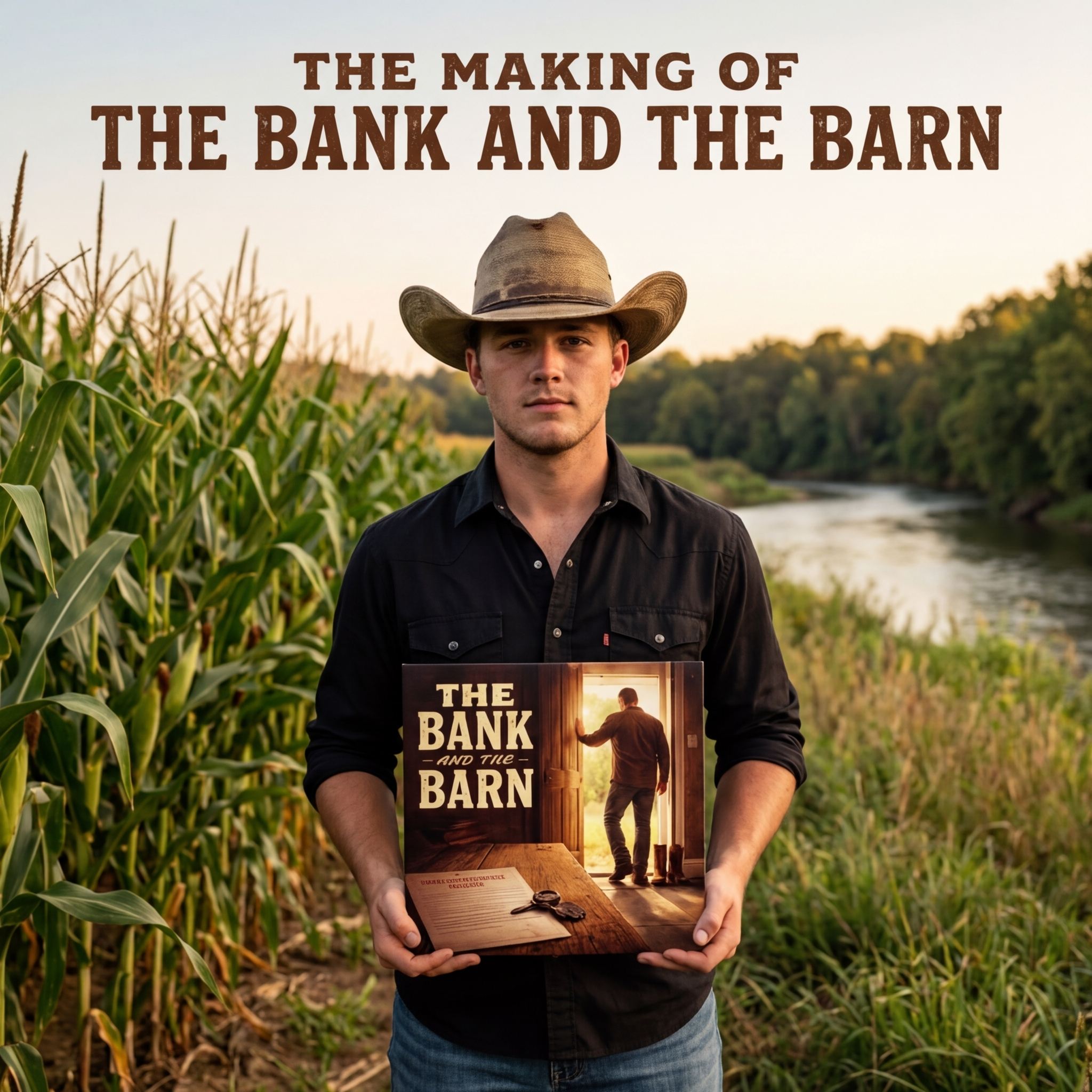
Family farms in America are failing.
We’ve reached a point where the math no longer works. In 2026, the cost of seed and fertilizer can outweigh what a crop brings at market. That reality sat heavy with me when The Bank and the Barn began to take shape.
From the start, I didn’t want this song to feel like a statistic or a headline. I wanted it to feel immediate—like a conversation on a front porch. A handshake that sounds friendly… until you realize what it really means.
“The bank and the barn said, we’ll do you no harm…
Just a pen and a promise to keep it all warm…”
That opening line sets the tone. It’s calm. Almost reassuring. But anyone who’s lived close to the land knows how quickly a promise turns into paperwork—and how fast things can shift beneath your boots.
Why This Song Needed to Be Written
I’m fortunate. The farm is paid for, and the land we rent helps cover the taxes. That’s not the reality for most families.
Every year, more American farmers are pushed to the edge—not because they failed, but because the numbers did.
I wasn’t raised on a farm, but I married into one. Many of my closest friends make their living this way. I’ve watched the pressure build year after year—the quiet stress that doesn’t show up in headlines, but lives in conversations, in decisions, in long nights staring at numbers that don’t add up.
This song didn’t come from trying to solve anything.
It came from listening.
The Bank and the Barn isn’t about politics or economics. It’s about what happens when hard work, legacy, and reality collide—and the numbers don’t care how long your name’s been on the deed.
The Title and the Metaphor
The title came early, and once it did, it guided everything.
The bank and the barn represent two sides of the same life.
The barn holds the work—the history, the seasons, the generations that came before.
The bank holds the numbers.
The barn remembers.
The bank records.
That contrast became the backbone of the song.
One day, you’re hearing “we’re here to help.”
The next, you’re signing papers that say you’re done.
It’s just business.
That emotional whiplash is where the song lives.
🎧 Listen to a quick 38 second sample of pre-chorus and chorus
🔊 Tip: Check your volume before playing the preview.
Letting the Details Do the Work
Verse one needed to feel real—specific enough that you don’t question it.
“But the rate climbed higher than July in the weeds…
And the crop wouldn’t cover what it cost for the seed…”
That’s not exaggeration. That’s happening.
Diesel tanks running low.
Mailboxes filling with warnings.
A family name still etched into a deed that no longer protects anything.
I didn’t want to explain the problem.
I wanted you to see it.
Because once you can see it, the story doesn’t need help.
The Turn — Where the Truth Shows Up
The pre-chorus is where everything shifts:
“Yeah, they look you in the eye like they’re shaking your hand…
But you can’t shake the truth of where it’s all gonna land…”
That moment is about inevitability.
The smile is real.
The handshake is real.
The outcome is already decided.
Once the math breaks, the ending writes itself.
Building the Chorus Around One Truth
Everything in this song comes back to one line:
“Yeah, the bank took the barn
But it never took the man”
The chorus lists what’s lost—land, gates, a name, a life built over decades.
But it draws a line.
There’s a difference between what you own… and who you are.
You can take the land.
You can take the buildings.
You can’t repossess a man’s identity, his memory, or his faith.
That’s why the chorus stays simple.
No clever turns.
No overthinking.
Just weight.
Making It Bigger Than One Story
Verse two widens the lens:
“Old man Carter by the fence line said, this is it”
He’s not a symbol. He’s someone you know.
Every community has him—the one who did everything right, worked every season, carried it forward… and still couldn’t make it hold.
This isn’t about one decision or one bad year.
It’s a slow bleed.
The Bridge — Where It Becomes Personal
The bridge is where the story stops being about land—and becomes about family:
“My boy’s boots still sittin’ by the back door frame
He don’t know we ain’t comin’ back again”
That’s the moment everything lands.
A child who doesn’t know yet.
A Bible on the table.
A foreclosure letter folded beside it.
Prayers for rain.
Prayers for sun.
And neither one changes the outcome.
Because when the day is done, the math doesn’t care.
What I Hope People Hear
This song isn’t about blame.
It’s about recognition.
It’s about sitting with the people who feel like the ground beneath them is giving way—and reminding them they’re not the only ones standing there.
Because the truth is:
The bank may take the barn.
It may take the land.
But it never takes the man.
That line isn’t defiance.
It’s survival.
And for a lot of families right now… survival is the win.
Link to the Song
If you’d like to hear a portion of The Bank and the Barn, you can listen to a 30-second sample here:
Explore more songs and stories at NashvilleLyrics.com
Where real stories turn into country songs.