Why the best songs aren’t written—they’re remembered
There’s a common mistake in songwriting.
Writers sit down and try to come up with something clever.
A hook. A twist. A big idea.
And sometimes that works.
But more often than not, the songs that actually land—the ones that feel real, the ones that stick—don’t come from trying to invent something.
They come from remembering something.
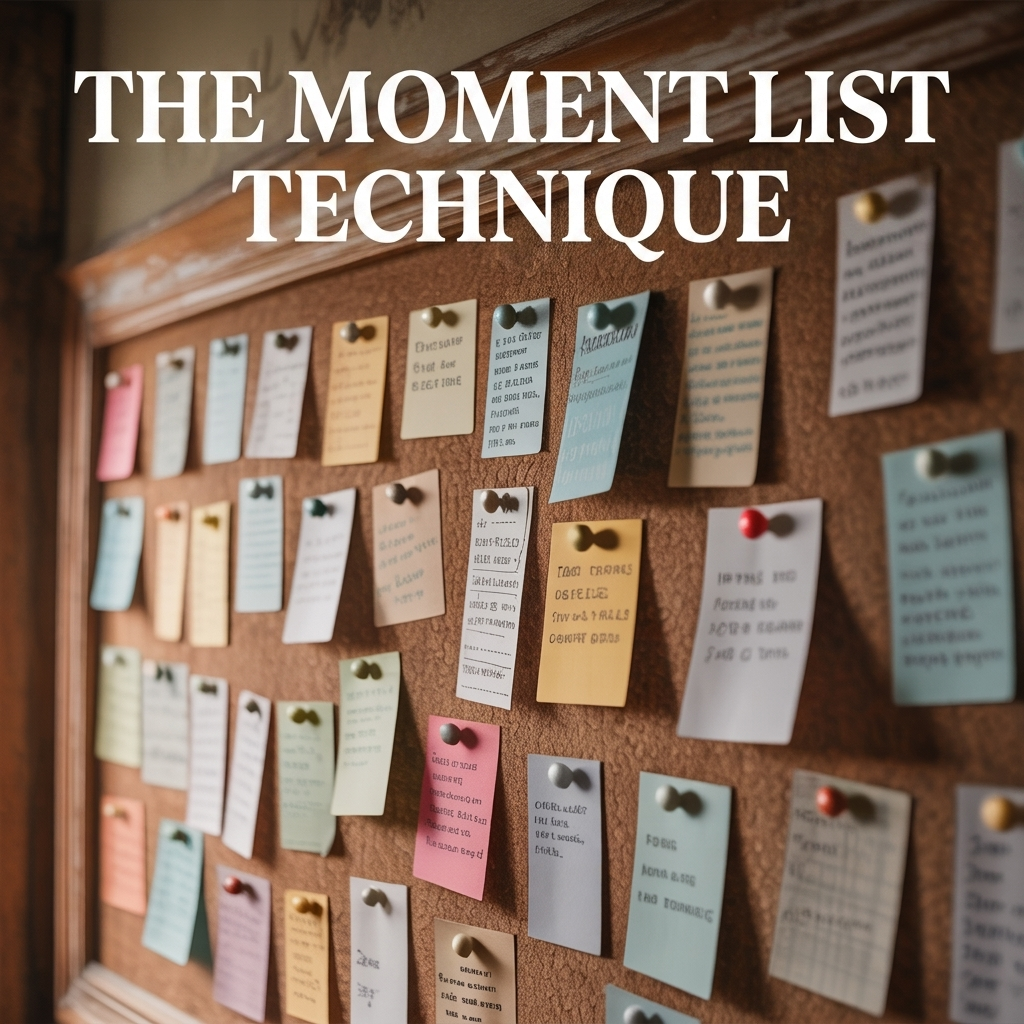
That’s where the Moment List Technique comes in.
What is the Moment List?
Before I write a song, I don’t start with lyrics.
I start with moments.
Not themes. Not concepts. Not rhymes.
Moments.
A moment is something you can see, hear, or feel like it’s happening right now.
- A truck idling outside a hospital at 2 a.m.
- A half-empty coffee cup sitting on a courtroom bench
- A text message that never gets answered
- A pair of boots still by the door
These aren’t ideas.
They’re snapshots.
And snapshots are what make songs believable.
Why this works (and why most writers skip it)
Most writers jump straight into structure.
Verse 1. Pre-chorus. Chorus.
But if you don’t know what actually happens in the story, structure won’t save you.
That’s how you end up with songs that sound right…
but don’t feel like anything.
The Moment List fixes that.
Because instead of asking:
“What’s my hook?”
You ask:
“What actually happened?”
Or better yet:
“What would prove this story is real?”
That question changes everything.
How to build a Moment List
It’s simple—but it requires honesty.
Before writing a single line, I’ll sit down and list out 10–20 moments connected to the idea.
No filtering. No polishing.
Just raw snapshots.
Let’s say the concept is Mother Over 40.
A Moment List for that might look like:
- Driving early morning with coffee and country radio on
- Seeing a woman walk into a convenience store with a young boy
- Assuming she’s the grandmother… then questioning that assumption
- The quiet house after the first child moves out
- Folding clothes in a room that’s finally still
- A doctor’s office with that familiar silence before the answer
- The flicker of a screen during an ultrasound
- Looking at your husband without saying a word
- The pause before the doctor speaks
- The words: “There’s two”
None of these are lyrics.
But every one of them is a doorway into a lyric.
The rule: If you can’t see it, cut it
This is the filter.
If a line doesn’t connect to a moment you can clearly picture…
it probably doesn’t belong in the song.
That’s where a lot of writers lose the listener.
They write lines like:
- “Life is hard sometimes”
- “Things don’t go as planned”
Those are true.
But they’re not visible.
Now compare that to:
- “The house got quiet when the last box left”
- “Coffee went cold on the kitchen counter again”
Now we’re somewhere.
Because the listener can step into that.
Turning moments into structure
Once the list is built, the song almost starts arranging itself.
You’re not guessing anymore—you’re selecting.
- Verse 1 → Where did this start?
- Pre-Chorus → What’s about to change?
- Chorus → What does it all mean?
- Verse 2 → What proves it’s real?
- Bridge → What’s the twist or truth?
You’re not writing from scratch.
You’re pulling from something that already exists.
That’s why the story feels grounded.
The hidden advantage: it keeps you honest
The Moment List does something else that matters.
It keeps you from writing what sounds good instead of what’s true.
Because once you’ve listed real moments, you can’t hide behind vague lines.
You have to answer:
Did this actually happen in the story?
If not—it stands out immediately.
That’s how you avoid songs that feel generic.
The hardest part
The hardest part of this technique is resisting the urge to write too soon.
Most writers get 2–3 good moments and jump straight into lyrics.
And that’s usually where the song stalls out halfway through.
Because they run out of real material.
The extra 10 minutes it takes to build a full Moment List…
will save you hours of rewriting later.
Three questions I always ask
When I’m building a Moment List, I come back to three things:
- What’s the turning point?
(The moment everything changes) - What image proves it?
(Not tells it—proves it) - What’s the line that carries the weight?
(The one the listener takes with them)
If I can answer those, the song has a foundation.
What this changes
When you start writing this way, something shifts.
You stop trying to impress the listener.
And you start letting them experience something.
Because the best songs don’t feel written.
They feel remembered.
Try it
Next time you sit down to write, don’t start with a hook.
Start with a list.
Ten moments. No pressure. No polish.
Just snapshots.
And then ask yourself:
Which one changes everything?
Explore more songs and stories at NashvilleLyrics.com
Where real stories turn into country songs.