Why Great Songwriters Know the Difference
Why Great Songwriters Know the Difference
Not every song has the same job.
Some songs are written for artists.
Some songs are written for audiences.
And understanding the difference can dramatically improve your songwriting.
Because what earns a cut isn’t always the same thing that earns a standing ovation.
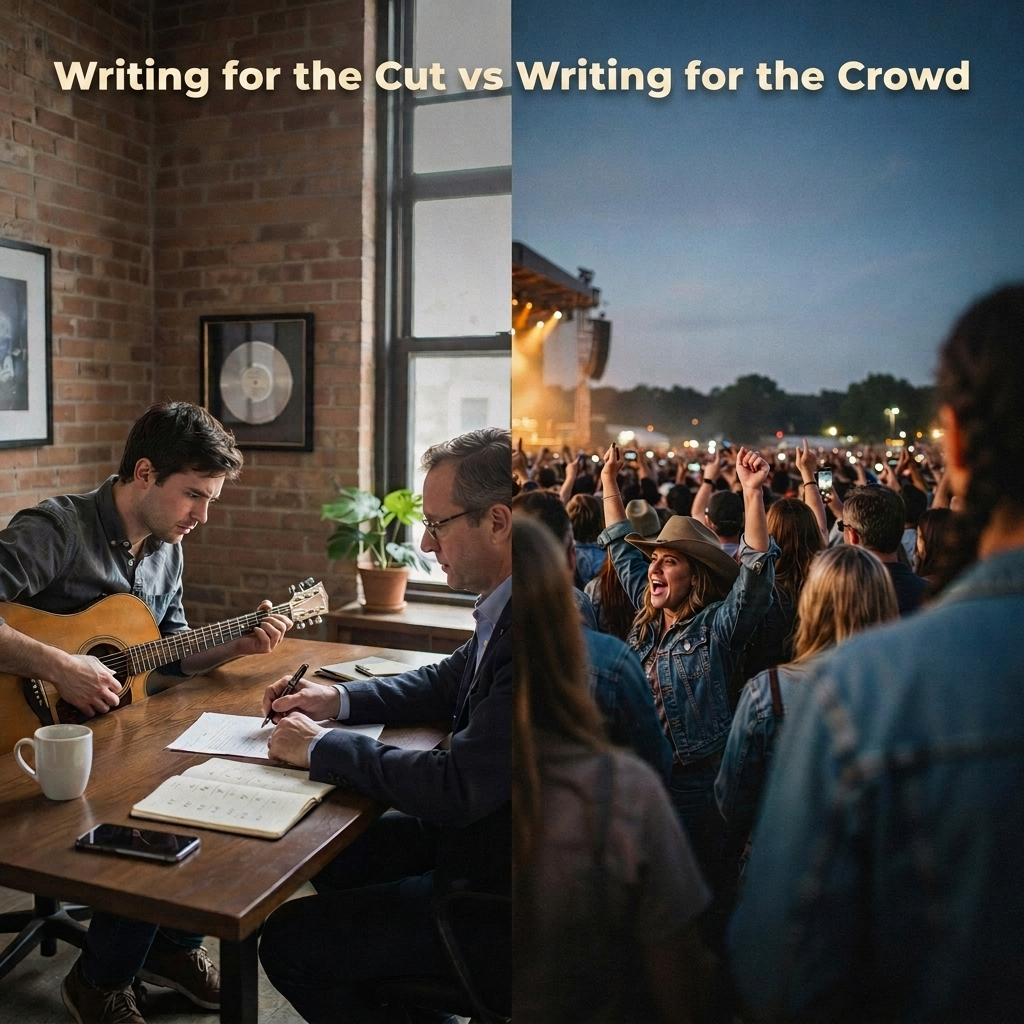
Writing for the Cut
When writing for a potential artist cut, the focus is usually:
- strong concepts,
- commercial relevance,
- artist fit,
- emotional clarity,
- and repeatability.
The song needs to fit into someone’s career.
That means the writer often prioritizes:
Would this artist want to say this?
Instead of:
Would this crowd enjoy hearing this?
Those are different questions.
Writing for the Crowd
Crowd songs are designed differently.
They’re built around:
- participation,
- energy,
- shared experiences,
- memorable hooks,
- and emotional accessibility.
Many concert favorites wouldn’t necessarily be the strongest pitch songs.
And many excellent pitch songs don’t create the biggest crowd reactions.
Both have value.
They simply serve different purposes.
Neither Approach Is Better
One mistake writers make is assuming one lane is superior.
It’s not.
Country music needs:
- radio songs,
- album songs,
- concert songs,
- and specialty songs.
Each lane serves a different audience and a different goal.
The best catalogs contain all of them.
Know What You’re Writing
Problems usually happen when writers don’t know which lane they’re targeting.
A song starts as a crowd anthem.
Then gets rewritten as a radio song.
Then picks up storytelling elements from an album track.
Eventually it becomes confused.
Clarity matters.
Great Writers Understand Purpose
Professional writers often identify the purpose of a song very early.
That purpose guides:
- structure,
- pacing,
- language,
- production,
- and emotional delivery.
The clearer the purpose, the stronger the final result.
The Best Catalogs Have Both
A songwriter who can only write crowd songs has limitations.
A songwriter who can only write pitch songs has limitations too.
Long-term success comes from understanding both.
And knowing when each one is needed.
Final Thought
Before writing the first line, ask yourself:
Am I writing for the cut,
or am I writing for the crowd?
The answer may shape every decision that follows.